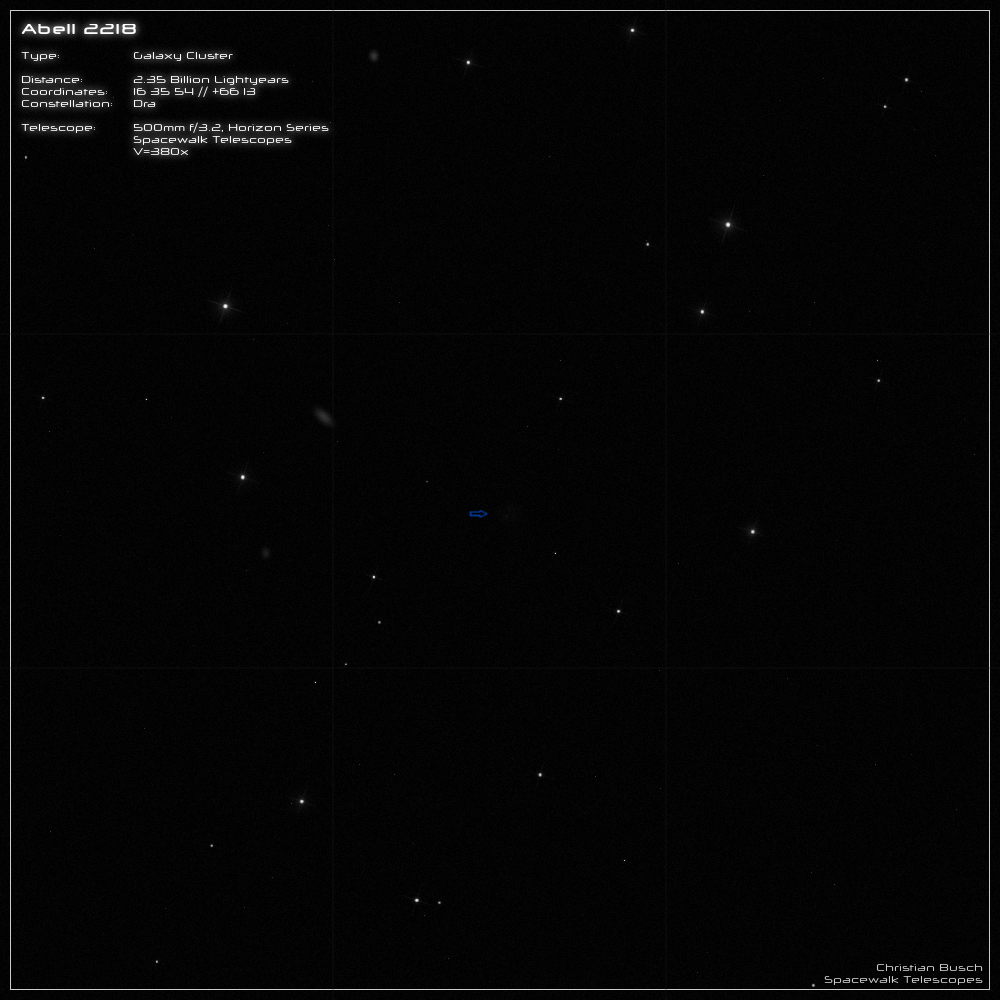
Galaxy Cluster Abell 2218
The galaxy cluster Abell 2218 is an exciting but very faint object in the northern sky. It is located in the constellation Draco and is circumpolar
for observers in the northern hemisphere, meaning it is visible all year round.
It was listed in 1958 by George O. Abell in his famous catalog of galaxy clusters.
Physically speaking, Abell 2218 is a very massive galaxy cluster located about 2.4 billion light-years from Earth (z=0.17). It consists of thousands of
galaxies. Its enormous mass, most of which consists of dark matter, generates such a strong gravitational field that the light from even more
distant galaxies is deflected and distorted. This phenomenon of gravitational lensing causes the images of the background galaxies to be not only
magnified but also distorted into long, arc-shaped structures. Analyzing these arcs allows astronomers to map the mass distribution within Abell 2218
and draw conclusions about the properties of dark matter. However, none of this can be seen even with a 20" telescope. Here, imagination comes into
play. ;)
At the center of Abell 2218 is a massive, central galaxy of the cD (central dominant) type. This elliptical galaxy, designated “LEDA 140648,” is
the brightest galaxy in the cluster with a brightness of 17.5 Bmag. It has a very extensive, faintly luminous shell of stars that extends over a
large area. Based on its apparent size of 18 arc seconds, its true size is calculated to be 200,000 light-years, making it larger than Messier 87 in the Virgo
cluster, for example.
----------------------------------------------------------------------------------------------------------------------------------------------
Even with an aperture of 50cm, Abell 2218 is a damn difficult object! Observation is somewhat simplified by the fact that there are many brighter stars
in the field of view, which make orientation easier.
At a magnification of 370x, I could occasionally see a larger, diffuse patch of light at the location I was looking for - probably the combined light of
the over thousand galaxies. I could also recognize the brightest galaxy (LEDA 140648) as a tiny, diffuse patch of light, although only a few times for
a few seconds.
In summary, it is a very difficult, but also very fascinating object! :)