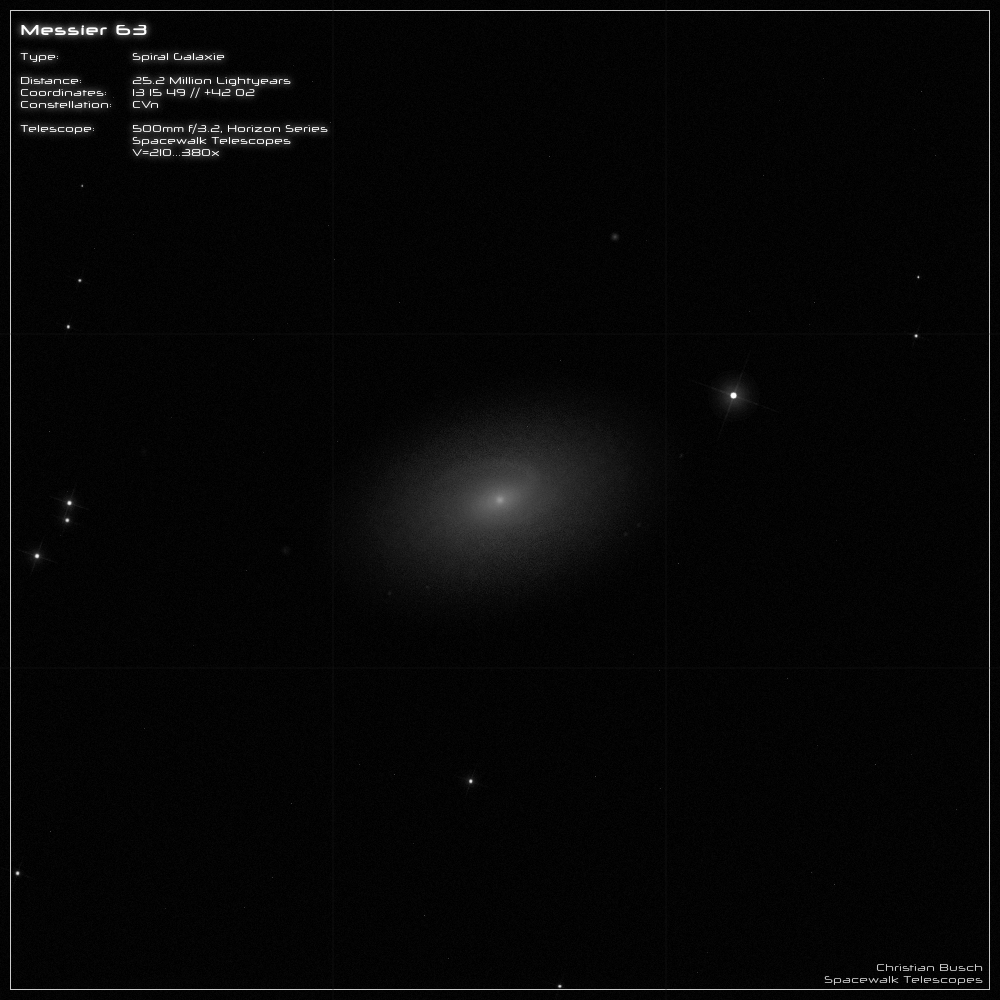
Messier 63 - Sunflower Galaxy
This beautiful and bright spiral galaxy was discovered by Pierre Méchain in June 1779 and shortly afterwards included in Charles
Messier's famous catalog. The first hints of spiral arms were seen by Lord Rosse in the mid-19th century.
With a brightness of 8.5 mag and an extension of 12.6'x7.2' arc minutes, Messier 63 is one of the largest and brightest galaxies in the
spring sky and can be seen with good binoculars under the right conditions.
The galaxy is located about 25 million light-years from Earth, but these values should be treated with caution, as values of up to 37
million light-years can also be found in the literature. The escape velocity is v= 484km/s, which means that the distance increases by
one light-year every 620 years.
Messier 63 belongs to the group of spiral galaxies of the Hubble Type “SA(rs)bc”. This means that it has no bar and only loosely wound
spiral arms. These appear interrupted and patchy (flocculent) in visible light. The diffuse knots are bright HII regions and star-forming
areas. In infrared light, two dominant spiral arms are visible, winding 150° around the core and extending to a distance of 13,000 light-years.
The diameter of the entire galaxy is 50,000 to 60,000 light-years, but a halo of hot gas extends much further into the surrounding space.
It is estimated that Messier 63 contains up to 400 billion stars, whose luminosity adds up to 20 billion suns, corresponding to an absolute
magnitude of M= -20.9mag.
The core area is also particularly interesting, with a diameter of 1,000 light-years and shining 6x brighter than its surroundings. At the
center there is an active galactic nucleus (AGN), which, according to the latest findings, contains a supermassive black hole (SMBH)
with a mass of 850 million suns.
Long-exposure photographs reveal a huge stream of stars, most likely created by the capture of a dwarf galaxy with a mass of 100
million suns.
So far, only one supernova has been observed in Messier 63: SN 1971I, which reached a maximum brightness of 11.8 mag at the end
of May 1971 and was even visible in a small telescope.
----------------------------------------------------------------------------------------------------------------------------------------------
Messier 63 looks truly wonderful in my 20" Dobsonian telescope. :))
The galaxy initially appears very bright with a high surface brightness. The halo is much brighter near the center than in the outer
areas. A brilliant stellar core can also be seen. After a while, the two spiral arms emerge from the brightened background. However,
they are very faint and can only be seen with averted vision. The northern arm (top) appears more prominent and larger.
The fine details are best seen at a magnification of 210...270x. After a while, the entire halo appears mottled and spotty, but the knots are
very faint, small, and subtle. They are barely perceptible, but nevertheless real. I have tried to indicate this in the drawing. Only the five
brighter HII regions, which I had marked on a DSS printout, were easier to see at 380x.
Unfortunately, I could not see the dark dust lane south of Messier 63 – only a rapid drop in brightness was visible.
A bright star west of the galaxy and a small group of stars on the other side provide a nice contrast. I was also able to make out two faint
galaxies east of Messier 63 and a third northwest of it.