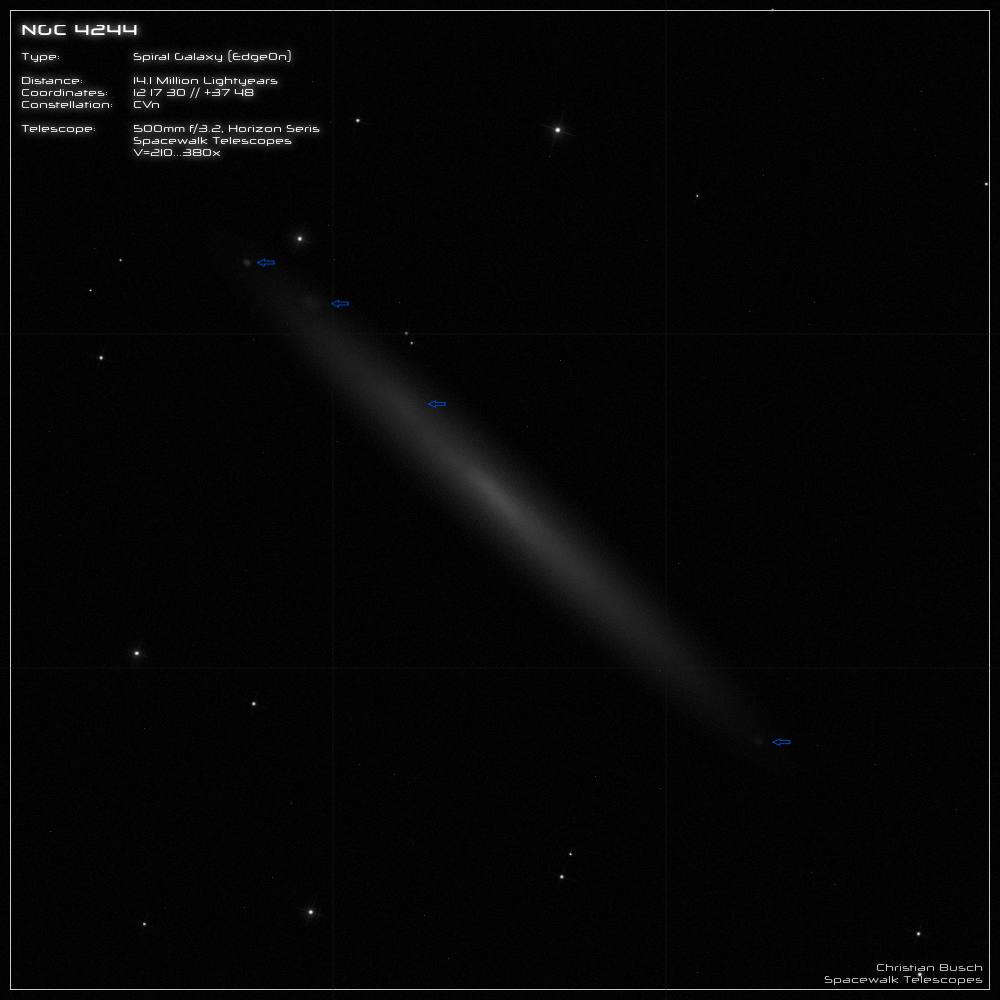
NGC 4244 - Galaxy
NGC 4244 is a beautiful edge-on galaxy that was discovered in April 1788 by F.W. Herschel in the constellation Canes Venatici (CVn). It
can be best observed in spring when it culminates high above our heads.
The galaxy is 13-16 million light-years away from Earth and, together with Messier 94 and Messier 106, belongs to the “CVn galaxy
group,” a neighboring group of the Local Group, which also includes our Milky Way. NGC 4244 has an apparent magnitude of 10.0
mag and a size of 16.6'x1.9'. Because the galaxy has a thickness ratio of 1:8 and no pronounced bulge, it belongs to the class of
“superthin” galaxies. Due to its low surface brightness of only 14.2 mag/"², it also belongs to the LSB galaxies (LSB = Low Surface
Brightness).
NGC 4244 has a diameter of 60,000 light-years, making it only half the size of our Milky Way. It is a spiral galaxy of the Hubble Type
“SA(s)cd”. The many billions of stars give the galaxy a total luminosity of 1.3 billion suns. This corresponds to an absolute magnitude
of M= -18.0mag, which is quite low for a galaxy of this size. The halo contains extensive star-forming regions, HII regions, and several
massive star clusters near the center.
----------------------------------------------------------------------------------------------------------------------------------------------
The galaxy NGC 4244 offers a great view in my 20" telescope under a dark sky. :)) The low surface brightness is immediately apparent,
which is why the galaxy appears only as a broad, relatively homogeneous streak of light in the eyepiece.
The galaxy is most beautiful at a magnification of 210x, at which some details can be made out. The center appears elongated and is only
slightly brighter than the rest of the galaxy. No stellar core is visible. The dust band is also not visible, not even hinted at, which is a bit of
a shame. ;) At the end of the elongated halo, two bright HII regions are visible, which were easy to see with averted vision. The situation
is different with the two weak star-forming regions, which are hard to spot.
North of the halo of NGC 4244, a faint double star can be seen.