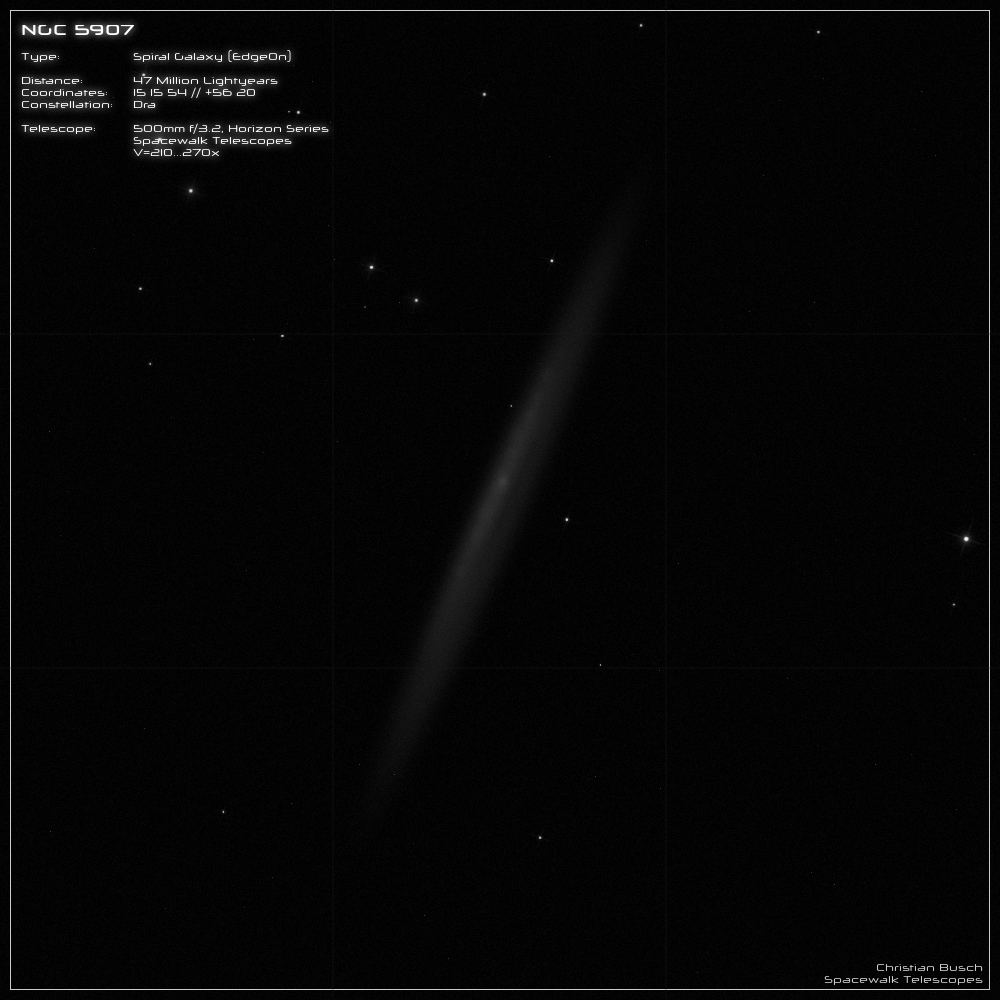
NGC 5907 - Splinter Galaxy
The spiral galaxy NGC 5907, also known as the “Splinter Galaxy,” was discovered in May 1788 by F.W. Herschel. It is located in the
constellation Draco and is about 40 to 50 million light-years away from Earth. Its apparent magnitude is about 11.1mag.
One remarkable feature of NGC 5907 is that we see the galaxy directly from the side. This is why it appears elongated and thin, with
no visible central bulge. Its estimated size is about 150,000 light-years in diameter, making it significantly larger than our own Milky Way.
Long exposure photos have revealed two huge streams of stars around the galaxy. These tidal streams, which in the case of NGC 5907
extend up to 150,000 light-years into intergalactic space, are probably the remains of a smaller dwarf galaxy. It is believed that this
dwarf galaxy collided with NGC 5907 more than four billion years ago and was torn apart by tidal forces. The stars of the smaller galaxy
were scattered around NGC 5907 in their orbit and now form this “ghost trail.” Visually, however, nothing can be seen of this!
----------------------------------------------------------------------------------------------------------------------------------------------
Under a dark sky, NGC 5907 is really amazing in my 20" f/3 telescope - the galaxy looks like a long cigar that is made of the light from billions
of stars. :)
It appears very large, but has a rather low surface brightness, which is why you should definitely go under a dark sky to see the galaxy in its
full beauty.
At a magnification of 270x, a faint dust band can be seen on the western side, but only in the central area of the galaxy. In the center of NGC
5907, a diffuse core can be seen - but without a stellar nucleus. The eastern side appears brighter and slightly mottled, even though I couldn't
clearly see the structures. The ends of the galaxy are rounded and fade gently into the surrounding space.